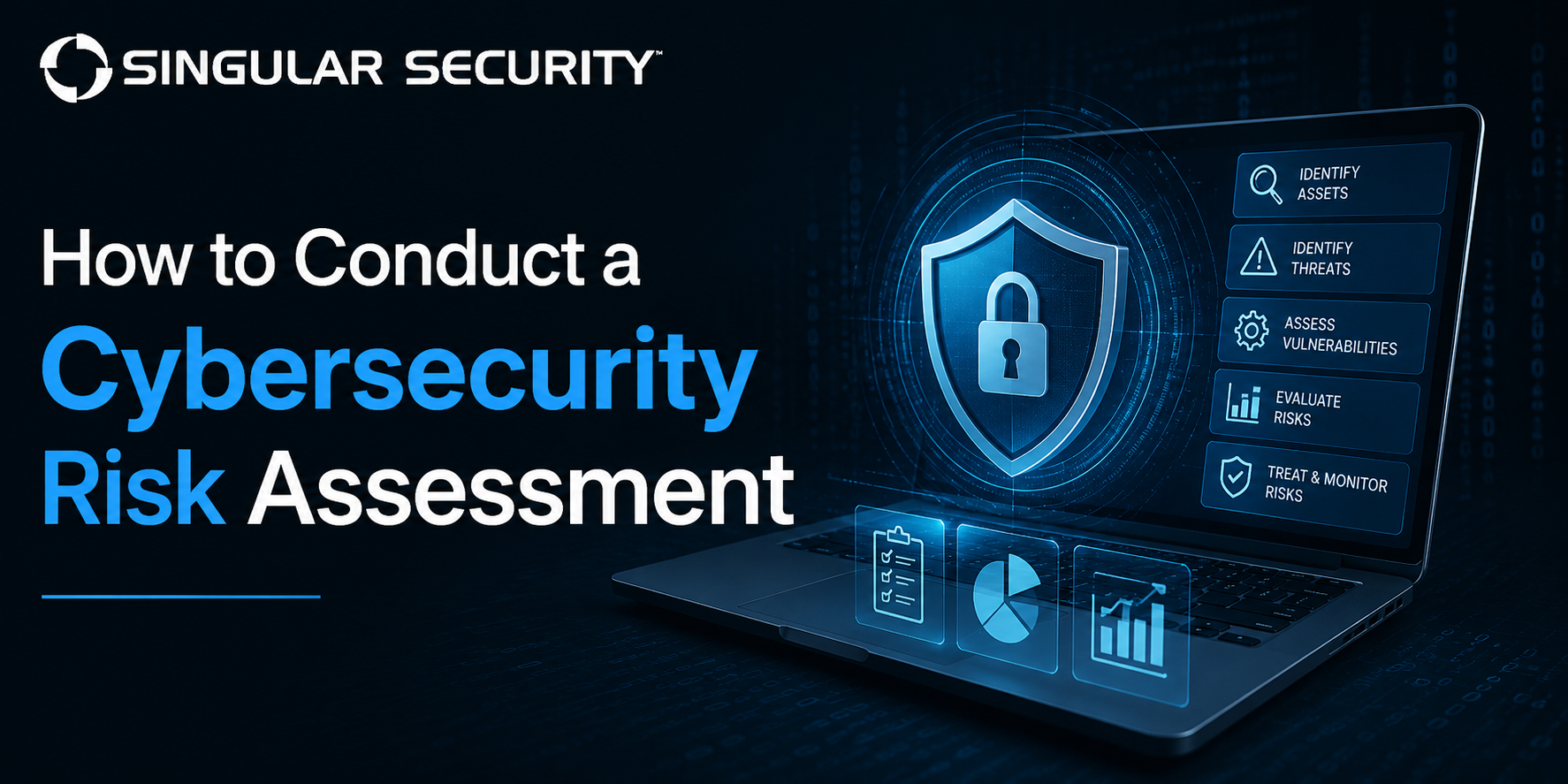
A security weakness can remain unnoticed for months before it becomes a serious business problem. New applications, cloud services, remote access, and third-party providers can create risks that are difficult to spot without a structured review. A cybersecurity risk assessment gives organizations a clearer view of where their exposure lies and which issues need attention first.
Singular Security helps businesses assess their security posture and identify areas where stronger protection may be needed. A good assessment looks beyond individual tools and considers systems, data, users, processes and the possible business impact of a security event.
Did you know? Verizon’s 2026 Data Breach Investigations Report found that vulnerability exploitation was involved in 31% of breaches, making it the leading initial access route identified in the report.
Key Takeaways
- A cybersecurity risk assessment helps identify threats, vulnerabilities and weaknesses across an organization’s systems, data and processes.
- The assessment starts by defining its scope and identifying critical assets that could affect business operations if compromised.
- Risk levels can be evaluated by considering the likelihood of an incident and its potential impact.
- Existing security controls should be reviewed to understand which risks are already reduced and where gaps remain.
- High-priority risks should be assigned clear actions, responsible owners and target dates.
- Regular reviews help keep the assessment relevant when systems, suppliers, business operations or security threats change.
What Is a Cybersecurity Risk Assessment?
A cybersecurity risk assessment involves an examination of the risks and vulnerabilities that may impact the systems of an organization. This process enables the security and IT professionals within the organization to gain insight into the areas of exposure as well as the degree of risks involved.
Four essential components should be included in a cyber risk assessment:
| Element | Meaning |
| Threat | Something that could cause harm |
| Vulnerability | A weakness that could be exploited |
| Risk | The possible harm created by a threat exploiting a weakness |
| Control | A safeguard used to reduce risk |
The assessment should also connect technical findings with business consequences, such as service disruption, data loss, financial costs, or regulatory issues.
Why Should Businesses Conduct a Cybersecurity Risk Assessment?
Security teams can have firewalls, endpoint protection and access controls in place while still having gaps elsewhere. An assessment helps reveal those gaps and gives decision-makers a clearer basis for setting priorities.
It can assist organizations:
- Find the weaknesses before they can be exploited.
- Safeguard confidential customer & business information.
- Identify systems needing stronger safeguards.
- Assist regulatory and audit requirements.
- Put security dollars where the risk is greatest.
- Better prepare for incidents and disruption of service.
This also makes an IT risk assessment useful as part of a larger review of technology, infrastructure and business operations.
How to Conduct a Cybersecurity Risk Assessment
1. Define the Scope
Start by deciding what the assessment will cover. This may include networks, endpoints, cloud services, applications, databases, offices and third-party platforms. A clear scope keeps the review focused and makes it easier to track findings.
2. Identify Critical Assets and Data
Create an inventory of the systems and information the organization relies on. Give particular attention to customer records, financial information, intellectual property, employee data and systems that support essential operations.
3. Identify Threats and Vulnerabilities
Consider the cybersecurity threats that could affect the environment, including phishing, ransomware, credential theft, malware, insider activity and unauthorized access.
Then look for weaknesses such as outdated software, poor access controls, excessive privileges, misconfigured cloud services and weak backup processes.
4. Review Existing Security Controls
An assessment should examine the safeguards already in place. Review measures such as multi-factor authentication, encryption, endpoint protection, firewalls, backups, security monitoring and staff training.
The goal is to understand the remaining exposure after current controls are considered.
5. Analyze and Score the Risks
This stage is where cyber risk analysis becomes useful. Each risk can be rated by considering its likelihood and potential impact.
A simple model is:
Risk = Likelihood × Impact
A phishing attack targeting privileged accounts, for example, may receive a higher rating than a low-impact issue affecting a non-critical device.
6. Prioritize the Findings
Every finding does not require the same response. Give priority to risks involving critical systems, sensitive data, high likelihood of exploitation or serious operational and regulatory consequences.
7. Create a Risk Treatment Plan
Decide how each significant risk will be handled. Options can include reducing, transferring, avoiding or accepting the risk.
Record the finding, risk level, recommended action, responsible person, deadline and progress status.
8. Document and Review the Results
The final report will contain an executive summary, scope of the assessment, key findings, risk ratings and recommended actions. Review the assessment after significant technology changes, new suppliers, security incidents or major changes in the threat landscape.
Common Cybersecurity Risk Assessment Mistakes to Avoid
Some problems can reduce the value of an assessment:
- Ignoring users & processes focusing only on technology.
- Assuming that all findings are equally urgent
- Excluding suppliers and cloud services from the review.
- Listing vulnerabilities without business impact
- Producing a report without responsibility for remediation.
- Treating the assessment as a one-off exercise.
Which Framework Should You Use?
Organizations can use recognized frameworks and guidance such as the NIST Cybersecurity Framework 2.0, NIST SP 800-30, ISO/IEC 27001 and CIS Controls. The right choice depends on the organisation’s size, industry, regulatory requirements and existing security programme.
NIST SP 800-30 provides guidance for assessing threats, vulnerabilities, likelihood and impact as part of risk management.
Ready to Identify and Prioritize Your Cybersecurity Risks?
A cybersecurity risk assessment is most useful when it leads to clear decisions. Identifying assets, weaknesses and threats is only the starting point. The next step is deciding which risks need attention, who should address them and how progress will be tracked.
Singular Security helps organizations assess their security posture, identify priority risks and determine the right next steps. Ready to get a clearer view of your organization’s cyber risks? Connect with Singular Security today and take the next step towards a stronger, more resilient security program.
FAQs
Q1. How often should a cybersecurity risk assessment be conducted?
There is no single schedule for every organisation. A formal review should be considered after major technology, business or security changes, with periodic reviews to keep findings current.
Q2. What are the main steps in a risk assessment?
The process includes defining scope, identifying assets, reviewing threats and vulnerabilities, assessing controls, rating risks, prioritising findings and creating remediation actions.
Q3. How do you calculate cybersecurity risk?
A simple method is to assess the likelihood of an event and multiply it by its potential impact. Organisations can then use Low, Medium and High ratings to set priorities.
Q4. What is a security risk assessment?
A security risk assessment reviews possible weaknesses, threats and consequences across an organisation’s security environment. The scope can include technology, people, processes and physical controls.
Q5. Who should conduct a risk assessment?
Internal security or IT teams can conduct assessments when they have the required skills and resources. External specialists can provide additional expertise or an independent view where needed.