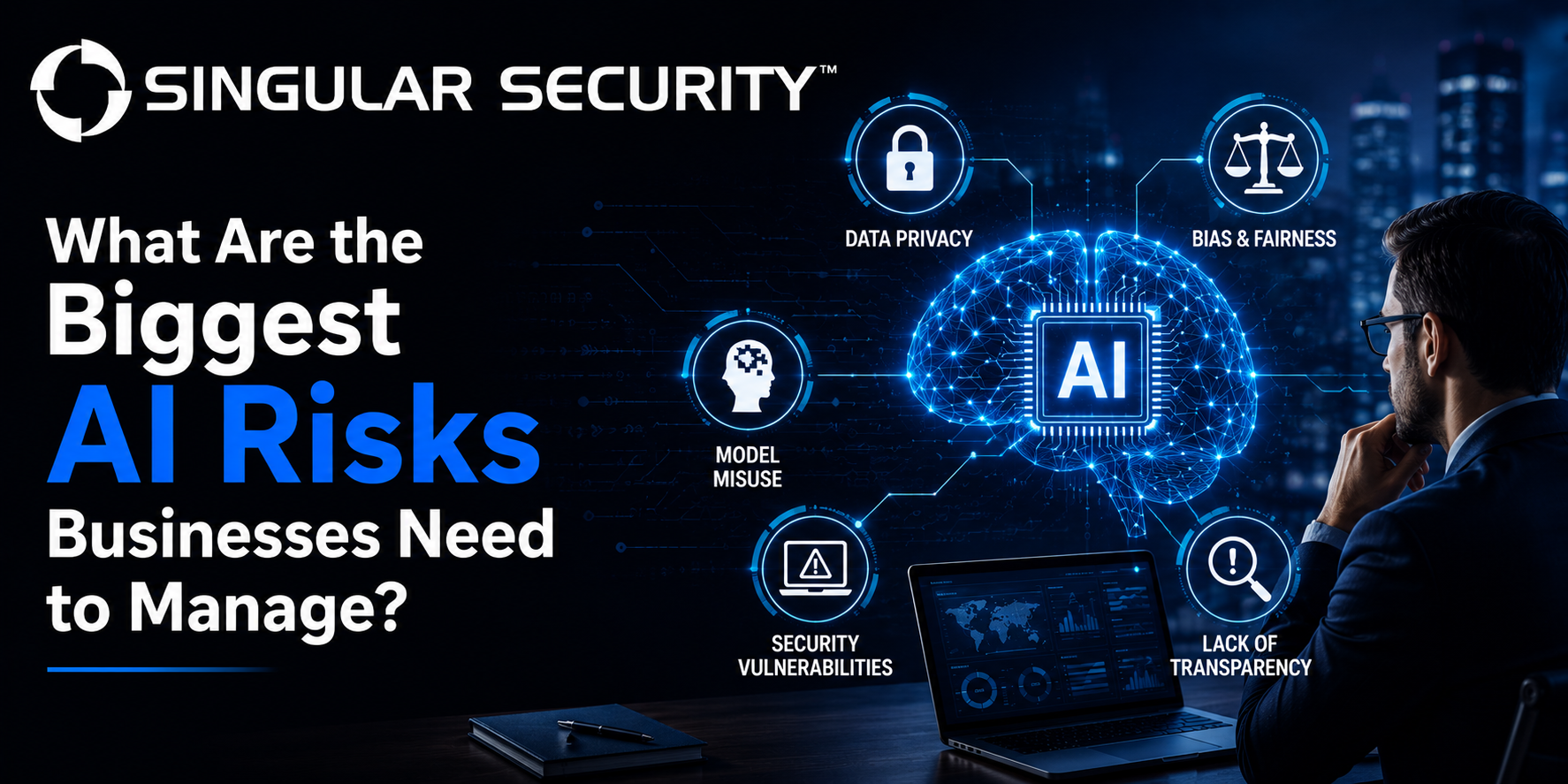
Artificial intelligence has moved from an experimental tool to a system embedded in core business operations, and that shift has changed the risk conversation entirely. AI risks for businesses now sit alongside ransomware and phishing as board-level concerns, not because AI itself is dangerous, but because of how quickly it is being adopted without matching oversight. From AI-generated deepfake fraud to unmonitored “shadow AI” tools quietly handling sensitive data, the exposure is real, measurable, and growing every quarter. This guide breaks down the biggest AI risks businesses need to manage in 2026, backed by current data, and outlines the practical steps a security-first organization takes to stay ahead of them.
Did you know? Global security leaders now rank AI as the single biggest driver of change in the threat landscape. In the World Economic Forum’s Global Cybersecurity Outlook 2026, published with Accenture, 87% of surveyed organizations named AI-related vulnerabilities as the fastest-growing cyber risk of the past year, and the report also found that data leaks tied to generative AI have overtaken concerns about AI-powered attacks as the top worry heading into 2026.
Key Takeaways
- AI-related vulnerabilities are now the top cybersecurity concern for most organizations, ahead of ransomware and traditional malware, according to global security leaders.
- AI is fueling a new category of fraud: voice cloning, deepfake video calls, and AI-generated phishing are already causing verified financial losses at scale.
- “Shadow AI” employees using unapproved AI tools is one of the fastest-growing sources of data exposure inside companies of every size.
- AI supply chain risk is a blind spot. Most organizations still don’t apply the same cyber risk management services and vendor scrutiny to AI tools that they apply to traditional software.
- Regulatory and compliance exposure is rising fast, with new AI-specific rules arriving even as many companies still lack a formal AI governance policy.
- A layered cyber risk management program covering monitoring, access control, employee training, and vendor oversight is what separates resilient businesses from reactive ones.
1. AI-Powered Cyberattacks and Deepfake Fraud
Attackers have adopted AI faster than most defenders have. Generative tools now let low-skill threat actors produce convincing phishing emails, cloned voices, and deepfake video in minutes, and this is one of the clearest AI security risks businesses face today. A finance employee joining what looks like a normal video call with the CFO, only to be approving a wire transfer to a fraudster, is no longer a hypothetical scenario, it’s a documented attack pattern.
For businesses, this means traditional “trust the voice, trust the face” verification is no longer safe for high-value transactions. Out-of-band confirmation (a callback to a known number, a second approver, a pre-agreed code word) has become a baseline control rather than an extra precaution. It also means detection needs to catch up: AI is increasingly used defensively too, flagging anomalous login patterns, unusual transaction requests, and behavioral red flags that a human reviewer would miss. If you want to understand how this works in practice, Singular Security has a detailed breakdown of how artificial intelligence detects cyber threats in real time.
2. Shadow AI and Uncontrolled Data Exposure
Shadow AI refers to employees pasting company data into public AI tools, chatbots, writing assistants, coding copilots without IT approval or oversight. It’s rarely malicious. It’s an employee trying to work faster. But every prompt typed into an unapproved tool is data leaving your security perimeter, and once it’s in a third-party model, you generally can’t get it back.
This is fundamentally a human-error problem before it’s a technical one, which is why security awareness training matters as much as any firewall. Employees need clear, simple rules: which AI tools are approved, what data can never be pasted into them, and who to ask when they’re unsure. Singular Security’s guide on how data security awareness training reduces human error covers how to build that culture without slowing teams down.
3. AI Supply Chain and Third-Party Model Risk
Every AI tool your business uses from a customer service chatbot to an embedded copilot in your CRM is also a third-party vendor with its own data handling practices, its own subprocessors, and its own security posture. Most companies apply rigorous vendor risk reviews to their software but skip that same scrutiny for AI features bundled into tools they already trust.
This is where cyber supply chain risk management becomes essential. It means knowing which AI vendors touch your data, understanding where that data is processed and stored, and building AI vendor assessments into your existing procurement process rather than treating AI as a special exception. For a deeper look at how to structure this, see Singular Security’s guide to what cyber supply chain risk management actually involves.
4. Regulatory, Compliance, and Governance Risk
AI regulation is moving quickly, and it’s inconsistent across states, countries, and industries. Businesses handling healthcare data, financial records, or consumer information now have to think about how AI use intersects with existing frameworks like HIPAA, SOC 2, and PCI DSS, on top of new AI-specific disclosure and risk-assessment requirements that are still taking shape.
The businesses managing this well aren’t waiting for a single federal standard to settle before acting. They’re documenting how and where AI is used, running periodic risk assessments against current requirements, and building in the flexibility to adjust as rules change. Singular Security’s overview of the benefits of a compliance risk assessment walks through how that process works in a business cybersecurity context.
5. Algorithmic Bias and Model Reliability Risk
AI models make mistakes with confidence, which is what makes this risk category dangerous. A hiring tool that quietly filters out qualified candidates, a fraud-detection model that flags legitimate customers, or a customer-facing chatbot that gives inaccurate information about pricing or policy each of these creates legal, reputational, and operational exposure, even without a single line of malicious code involved.
Managing this risk means treating AI outputs the way you’d treat any other high-stakes business decision: with human review, documented decision logic, and periodic audits of accuracy and fairness. Businesses in regulated industries especially need an audit trail showing how and why an AI system reached a given decision.
6. Building a Cyber Risk Management Program That Covers AI
None of the risks above are managed with a single tool or a one-time policy. They require an ongoing cyber risk management program that treats AI as part of the broader attack surface, not a separate category to deal with later. A mature program typically includes:
- Continuous monitoring of network activity and AI tool usage to catch anomalies early
- Identity and access controls that limit what data any AI tool, human, or automated agent can reach
- Vendor and supply chain review for every AI tool touching company data
- Employee training focused specifically on AI-related social engineering and data handling
- Incident response planning that accounts for AI-enabled fraud scenarios, not just traditional breaches
The U.S. National Institute of Standards and Technology (NIST) publishes a voluntary AI Risk Management Framework that many organizations use as a starting structure for exactly this kind of program, mapping AI-specific risks against governance, measurement, and response practices.
For businesses that don’t have the internal bandwidth to build and run this in-house, working with a partner that offers dedicated cyber risk management services can close the gap quickly. Singular Security’s security monitoring services are built to give businesses continuous visibility into exactly these kinds of emerging threats, AI-driven or otherwise.
Ready to Get Ahead of AI Risk?
AI risk isn’t a future problem; it’s already shaping fraud attempts, vendor relationships, and compliance requirements happening inside your business today. Singular Security helps businesses build the monitoring, governance, and response capabilities needed to manage AI risk alongside every other layer of cybersecurity. Talk to our team about a risk assessment tailored to how your business actually uses AI.
FAQs About AI Risks for Businesses
Q1. What are the biggest AI risks businesses face right now?
The most pressing risks are AI-powered fraud (deepfakes and voice cloning), shadow AI data leakage, weak oversight of third-party AI vendors, regulatory and compliance gaps, and algorithmic bias in AI-driven decisions.
Q2. Is AI a bigger cybersecurity risk than traditional threats like ransomware?
Global security leaders now rank AI-related vulnerabilities as the fastest-growing cyber risk, but it’s compounding traditional threats rather than replacing them. Attackers are using AI to make ransomware, phishing, and fraud more convincing and harder to detect.
Q3. What is shadow AI, and why is it a security risk?
Shadow AI is the use of AI tools by employees without IT approval or oversight. It’s risky because sensitive company data pasted into unapproved tools can leave the organization’s control entirely, with no way to retrieve or delete it.
Q4. How does cyber supply chain risk management apply to AI tools?
Every AI feature or tool connected to company systems is effectively a third-party vendor. Cyber supply chain risk management means reviewing how each AI vendor handles data, where it’s processed, and what security controls they maintain, just as you would for any other software vendor.
Q5. Do small and mid-sized businesses need to worry about AI risk, or is this just an enterprise problem?
Smaller businesses are often more exposed, not less, because they typically have fewer formal AI policies, less budget for continuous monitoring, and are frequent targets for AI-enabled fraud precisely because attackers assume weaker controls.
Q6. What’s the first step a business should take to manage AI risk?
Start with visibility: inventory every AI tool currently in use across the organization, including tools employees have adopted informally, then build governance and monitoring around what you find.