Every workload a company moves to the cloud adds convenience and a new way for something to go wrong. Cloud security risks are the vulnerabilities, misconfigurations, and gaps in oversight that let attackers reach data and systems hosted outside a company’s own walls. For IT and security teams managing hybrid or multi-cloud environments, these risks aren’t hypothetical; they show up as exposed storage buckets, over-permissioned accounts, and API calls that never should have succeeded.
This guide breaks down the most common cloud threats and cloud vulnerabilities businesses face right now, why they keep happening despite better tooling, and what a practical risk-reduction plan looks like. If you’re responsible for cloud data security at your organization, treat this as a working checklist, not just background reading.
Did you know?According to IBM’s 2026 Cost of a Data Breach Report, the global average cost of a data breach reached a record $4.99 million in 2026, a 12% increase year over year, with U.S. organizations averaging $11.5 million per breach more than double the global figure. Detection, escalation, and lost business from operational disruption accounted for nearly two-thirds of total breach costs.
Key Takeaways
- Misconfiguration, not provider failure, is the leading cause of cloud security incidents.
- Identity and access management is now the primary control point for cloud risk MFA and least-privilege access matter more than perimeter defenses.
- Insecure APIs, insider threats, and shadow IT create blind spots that traditional security monitoring can miss.
- Continuous monitoring and regular access reviews catch drift that point-in-time audits don’t.
- Cloud risk extends to third-party vendors and compliance posture, not just your own infrastructure.
What Are Cloud Security Risks?
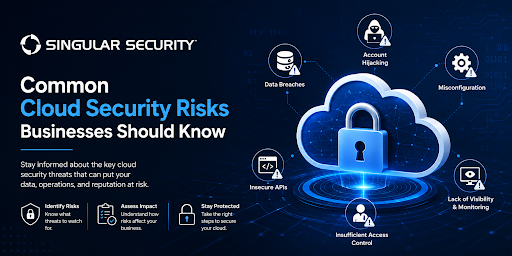
Cloud security risks are the potential threats and weaknesses that can compromise the confidentiality, integrity, or availability of data and applications hosted in public, private, or hybrid cloud environments. Unlike traditional on-premises risk, cloud risk sits at the intersection of what the provider secures and what the customer configures, a split known as the shared responsibility model. Most incidents trace back to the customer side of that line: identity, configuration, and access control, not a flaw in the provider’s underlying infrastructure.
Why Cloud Security Risks Are Increasing
Cloud adoption has outpaced cloud governance at most organizations. Teams spin up new services in minutes, but security reviews, access audits, and configuration baselines often lag weeks behind. A few forces are driving the increase in exposure:
- Multi-cloud sprawl makes it harder to maintain consistent security controls across AWS, Azure, and Google Cloud simultaneously.
- Faster deployment cycles mean infrastructure changes ship before security review catches up.
- AI-assisted development and “vibe coding” introduce unvetted dependencies and configuration patterns at speed.
- Remote and hybrid work has expanded the number of devices and networks connecting to cloud resources.
1. Cloud Misconfigurations
Misconfiguration remains the single most common cloud security failure. It happens when storage buckets, databases, or network settings are left open, overly permissive, or simply set up incorrectly during deployment not because the cloud provider’s infrastructure failed.
Typical misconfiguration failures include:
- Publicly accessible storage buckets that were never meant to face the internet
- Default credentials or open ports left unchanged after deployment
- Overly broad IAM policies granting more access than a workload needs
- Disabled logging or monitoring on newly created resources
If a threat serious enough to warrant a binding federal directive is largely a self-inflicted configuration problem, it’s worth auditing how your own team handles vulnerability baselining before an attacker finds the gap first.
2. Weak Identity and Access Management
Identity has effectively become the new perimeter in cloud environments. When access controls are too permissive, poorly monitored, or built on weak authentication, attackers don’t need to breach infrastructure; they just need one set of valid credentials.
Common IAM weaknesses include:
- Standing admin privileges granted to accounts that only need them occasionally
- No enforced multi-factor authentication (MFA) on privileged or service accounts
- Stale accounts from former employees or decommissioned services that were never removed
- Shared credentials used across multiple services or team members
Expert Insight: Teams that treat identity and access management as a one-time setup task, rather than an ongoing discipline, are the ones that get caught out. Access reviews need to happen on a cadence, not just during onboarding or an audit cycle.
Strengthening this layer typically starts with least-privilege access and continuous credential monitoring, the same principles covered in a broader identity and access management strategy for cloud computing.
3. Insecure APIs
APIs are how modern cloud applications talk to each other, which makes them a direct and frequently targeted attack surface. An API without proper authentication, rate limiting, or input validation can expose the same sensitive data a database would just through a less obvious door.
- Broken or missing authentication on internal-facing APIs
- Excessive data exposure returning more fields than the client actually needs
- No rate limiting, allowing brute-force or scraping attacks
- Shadow APIs that were never documented or retired properly
API security review should be a standing item in release pipelines, not a one-off penetration test finding that gets patched and forgotten.
4. Data Breaches and Data Loss
Data breaches are usually the outcome of the risks above, not a separate category: a misconfigured bucket, a compromised credential, or an exposed API all lead to the same result: sensitive data leaving the organization’s control.
Beyond the direct financial hit, businesses face regulatory penalties, breach notification obligations, customer churn, and reputational damage that can outlast the incident itself by years.
5. Insider Threats
Not every cloud threat originates outside the organization. Insider threats, whether malicious, negligent, or simply the result of human error remain one of the harder risks to catch because insiders already have legitimate access.
- Employees exfiltrating data before leaving the company
- Accidental exposure through misdirected file sharing or overly broad sharing permissions
- Contractors or third parties retaining access after a project ends
Pro Tip: Pair access reviews with offboarding automation. Manual offboarding checklists are where stale access most often slips through.
6. Shadow IT and Unsanctioned Cloud Use
Shadow IT cloud apps, storage, or AI tools adopted by employees or teams without security team approval creates blind spots that security can’t monitor or protect because they don’t know the asset exists.
This has grown more urgent with the rapid adoption of AI tools inside business workflows. Unapproved AI tools processing company data outside sanctioned environments is now a recognized and growing incident category, not a fringe concern.
7. Compliance and Regulatory Gaps
Cloud environments change faster than compliance documentation typically keeps up. A configuration change made for a product launch can silently take an organization out of alignment with HIPAA, PCI DSS, SOC 2, or NIST requirements without anyone noticing until an audit.
This is exactly the gap continuous compliance risk assessment processes are built to close, treating compliance as an ongoing state to maintain rather than a snapshot taken once a year.
How to Reduce Cloud Security Risks
A resilient cloud security posture doesn’t come from a single tool it comes from layered practices applied consistently:
Establish a Configuration Baseline
Know what “secure” looks like for every service you run, then continuously check drift against that baseline rather than relying on a one-time setup review. Establishing a vulnerability baseline gives security and IT teams a shared reference point for what’s changed and what needs remediation.
Enforce Least-Privilege Access
Grant only the access a role or service actually needs, require MFA on all privileged accounts, and review permissions on a set cadence rather than only during onboarding.
Monitor Continuously, Not Periodically
Point-in-time audits miss the changes that happen between them. Continuous monitoring closes that gap by tracking network assets, vulnerabilities, and emerging threats as they happen.
Extend Risk Management to Vendors
Cloud risk doesn’t stop at your own infrastructure third-party and supply chain exposure is part of the same risk surface. A cyber supply chain risk management approach accounts for vendors and integrations that touch your cloud environment.
Based on the compliance and vulnerability assessments we’ve run across small businesses and regulated enterprises alike, the organizations that avoid costly incidents aren’t the ones with the biggest security budgets; they’re the ones that treat configuration checks and access reviews as routine operational hygiene, not annual events.
FAQs
Q1. What are the most common cloud security risks businesses face?
The most common cloud security risks are misconfigurations, weak identity and access management, insecure APIs, data breaches, insider threats, shadow IT, and compliance gaps. Misconfiguration remains the single largest category, driven primarily by human error rather than provider infrastructure failures.
Q2. What is the difference between cloud vulnerabilities and cloud threats?
A cloud vulnerability is a weakness like an overly permissive access policy or an unpatched service that could be exploited. A cloud threat is the actual actor or event, such as a credential-stuffing attack or ransomware campaign, that could exploit that vulnerability. Vulnerabilities create the opening; threats are what tries to use it.
Q3. Who is responsible for cloud security, the provider or the business?
Responsibility is shared. Cloud providers secure the underlying infrastructure, while businesses are responsible for configuring their own resources, managing access, and protecting their data; this is known as the shared responsibility model. Most incidents originate on the customer side of that line.
Q4. How often should businesses review their cloud security posture?
Configuration and access reviews should happen continuously, not just annually. Point-in-time audits routinely miss the drift that happens between review cycles, which is why continuous monitoring has become the standard recommendation over periodic checklists.
Q5. Can small businesses be affected by cloud security risks, or is this mainly an enterprise concern?
Small businesses are frequently targeted precisely because they tend to have fewer dedicated security resources and less mature access controls, making misconfigurations and credential-based attacks easier to exploit at scale.
Q6. What’s the fastest way to reduce cloud security risk right now?
Start with an access audit: remove standing admin privileges that aren’t necessary, enforce MFA on every privileged account, and check public-facing storage and databases for unintended exposure. These three steps address the highest-frequency root causes of cloud incidents.