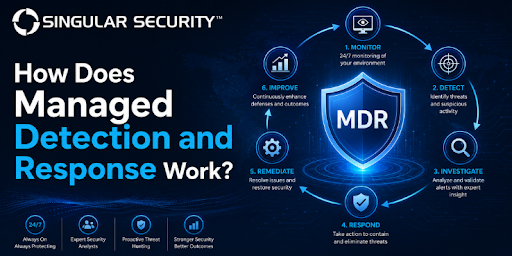
How does MDR work? Managed Detection and Response works by combining round-the-clock monitoring technology with human security analysts who watch your network, endpoints, and cloud systems, hunt for threats that automated tools miss, and step in to contain an attack before it spreads, not just alert you that something happened.
Did you know? The FBI’s Internet Crime Complaint Center (IC3) logged $20.877 billion in reported cybercrime losses in 2025, a 26% jump from the year before, underscoring how much damage unmonitored gaps can cause.
For most businesses, the gap isn’t a lack of security tools. It’s that nobody is watching those tools at 2 a.m. on a Sunday. That’s the exact gap MDR cybersecurity was built to close. This guide breaks down how threat detection and security monitoring actually happen inside an MDR service, step by step.
Key Takeaways
- MDR pairs continuous, automated monitoring with human analysts who investigate and act on threats; it doesn’t just generate alerts and leave you to handle them.
- The core workflow is to collect, detect, investigate, respond, and report running 24/7 across endpoints, networks, cloud, and identity systems.
- Threat hunting is an active part of MDR, not a passive one; analysts look for attackers who have already evaded automated detection.
- Managed security through MDR is built to cut the time between an intrusion and its containment from weeks to minutes or hours.
- MDR is a service, not a single tool; it typically layers on top of EDR, network monitoring, and cloud logging rather than replacing them.
- Smaller organizations benefit the most, since MDR provides 24/7 coverage without needing an in-house security operations team.
What Is Managed Detection and Response (MDR)?
Managed Detection and Response is a cybersecurity service where a dedicated provider monitors your environment around the clock, actively hunts for threats, and takes action to contain them instead of just sending you an alert and stepping back.
It’s the difference between a smoke detector and a fire department. A basic monitoring tool tells you something is wrong. MDR cybersecurity puts trained people on the other end who investigate what triggered the alert, confirm whether it’s a real threat, and respond immediately if it is.
How Does MDR Work? The Step-by-Step Process
Every MDR engagement runs on roughly the same cycle, whether the target is an endpoint, a cloud workload, or a piece of network traffic:
- Data collection sensors and agents continuously pull telemetry from endpoints, network traffic, cloud platforms, and identity systems.
- Threat detection that telemetry is analyzed against known attack patterns, behavioral baselines, and threat intelligence feeds to flag anomalies.
- Human investigation analysts review flagged activity to separate real threats from false positives, something automated tools alone consistently get wrong.
- Active response confirmed threats are contained directly: isolating a device, killing a malicious process, or disabling a compromised account.
- Reporting and tuning findings feed back into detection rules so the same attack pattern is caught faster next time.
This cycle is what separates real security monitoring from a dashboard nobody watches. If you want to see how these same detection principles play out specifically around identity-based attacks, our guide on how zero trust security works to stop cyber attacks covers the overlap in more depth.
Threat Hunting: The Proactive Half of MDR
Detection tools only catch what they’re built to recognize. Threat hunting is the proactive side of MDR analysts who go looking for attackers who are already inside the network, using techniques designed to avoid tripping automated alerts. This is usually what catches slow, quiet intrusions before they turn into ransomware or full data theft.
MDR vs. Traditional Security Monitoring
Here’s how MDR compares to older-style monitoring and alerting:
| Factor | Traditional Monitoring / MSSP | Managed Detection and Response (MDR) |
|---|---|---|
| Focus | Generates and forwards alerts | Investigates, contains, and helps remediate threats |
| Coverage | Logs and signature-based rules | Endpoints, network, cloud, identity, and behavior |
| Human involvement | Alerts reviewed only when escalated | 24/7 human threat hunters analyze and act |
| Speed | Detection can lag for days or weeks | Built around minutes-to-hours response times |
| Outcome | You’re told something happened | The threat is actively contained for you |
A lot of businesses assume they already have this covered because they have antivirus software or a firewall logging traffic. Those tools generate data. MDR is what turns that data into an actual response which is the piece most in-house IT teams don’t have the staff or the hours to run 24/7.
Core Components of an MDR Service
Endpoint Detection and Response (EDR) Integration
MDR providers typically deploy or integrate with EDR agents on laptops, servers, and workstations to catch malicious activity at the device level. Our overview of endpoint security for businesses covers what these agents actually watch for.
24/7 Security Operations Center (SOC) Monitoring
This is the human layer analysts staffing a security operations center around the clock, reviewing alerts, and escalating real incidents. We break down what this looks like day to day in how SOC monitoring services detect cyber threats in real time.
Threat Intelligence Feeds
MDR services pull in constantly updated data on known attacker tactics, malicious IP addresses, and emerging malware signatures, so detection isn’t limited to what a single organization has seen before.
Incident Response and Containment
When a real threat is confirmed, MDR teams act directly isolating infected devices, revoking compromised credentials, and walking the organization through recovery. This connects closely with identity and access management, since compromised credentials are one of the most common containment scenarios.
Why Managed Security Through MDR Matters Right Now
Most successful attacks don’t announce themselves. They start small with a phished credential, a misconfigured cloud bucket, a single infected laptop and spread quietly while nobody’s looking. Without continuous monitoring, that quiet spread can go unnoticed for weeks.
MDR closes that window. Instead of discovering a breach after the damage is done, an MDR provider is watching in real time, ready to act the moment something looks wrong. That kind of coverage is difficult and expensive to build in-house, which is exactly why managed security has become the practical answer for businesses that can’t staff a 24/7 security team on their own.
An Honest Take on Choosing an MDR Provider
Having reviewed a number of MDR engagements across different-sized businesses, the biggest differentiator isn’t the technology stack; most providers use comparable tools. It’s response time and how much of the work is genuinely handled for you versus just flagged for your team to fix. Before signing with any provider, ask for their actual mean time to respond, not just their mean time to detect. Detecting a threat and doing something about it are two different numbers, and only one of them protects your business.
Common Mistakes Businesses Make With MDR
- Assuming MDR replaces internal IT it complements internal teams by handling continuous monitoring and response, not day-to-day IT operations.
- Choosing a provider based on alert volume more alerts isn’t better; fewer, accurately investigated alerts save time and reduce fatigue.
- Leaving cloud and identity systems out of scope attackers increasingly target cloud accounts, not just on-premise devices.
- Not clarifying response authority upfront know exactly what actions your MDR provider can take without waiting on your approval during an active incident.
- Treating onboarding as a one-time setup detection rules need regular tuning as your environment and the threat landscape change.
MDR in Plain English
In plain English: MDR works by watching your systems all day, every day, using both software and real people, so that when something suspicious happens, someone actually notices and does something about it within minutes instead of weeks.
Ready to Put 24/7 Threat Detection to Work?
Knowing how MDR works is one thing. Having it actually watching your business is another. The gap between the two is usually staffing, budget, or simply not knowing where to start and none of those have to stay a blocker.
Singular Security builds managed detection and response around your actual environment, not a one-size-fits-all package. Talk to our team about security monitoring services to see what real 24/7 coverage would look like for your business.
Frequently Asked Questions
Q1: How does MDR work in simple terms?
MDR combines continuous monitoring technology with human security analysts. The technology collects data and flags anomalies; the analysts investigate those flags, confirm real threats, and take action to contain them, day or night.
Q2: What’s the difference between MDR and a managed security service provider (MSSP)?
A traditional MSSP often focuses on managing security tools and forwarding alerts. MDR goes further by including active threat hunting and hands-on incident response, not just alert delivery.
Q3: Is MDR the same as antivirus or EDR software?
No. EDR is a piece of technology that monitors endpoints. MDR is a full service that includes EDR (or works alongside it) plus 24/7 human monitoring, threat hunting, and direct incident response.
Q4: How fast can MDR respond to a threat?
Well-run MDR services are built around response times measured in minutes to a few hours, not days. The speed depends heavily on how much authority the provider has to act without waiting for client approval.
Q5: What data sources does MDR typically monitor?
Most MDR services cover endpoints (laptops, servers), network traffic, cloud platforms, and identity or authentication logs since modern attacks frequently move across more than one of these at once.