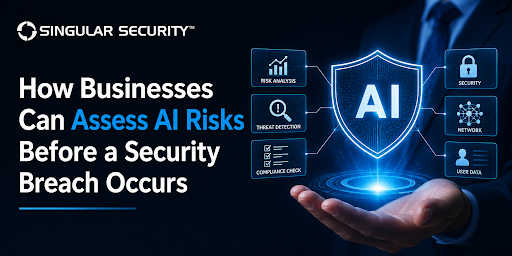
AI is quickly becoming part of everyday business operations. Employees use AI tools to work with documents, developers connect models to applications, and customer-facing systems may rely on AI to answer questions or automate tasks. Each use case can introduce security risks if data, access, integrations, and permissions are not reviewed before deployment.
Did you know? NIST’s AI Risk Management Framework recommends four core functions for managing AI risks: govern, map, measure, and manage. The framework is designed to help organizations identify and address risks throughout the AI lifecycle.
A well-planned AI security risk assessment can help businesses identify weaknesses before they become security incidents. Singular Security supports organizations with cybersecurity, risk management, security assessments, and related services, helping teams understand where security gaps may exist and what needs attention.
Key Takeaways
- AI may pose risks via data, permissions for accessing data, applications, models, and third parties that provide the service.
- AI security risk assessment allows organizations to identify and analyze these risks prior to implementation and changes.
- Identify sensitive data prior to sharing it with the AI system.
- Organizations need to understand what access and actions each AI application has.
- Detection technologies can help detect suspicious activity, but only when combined with good security controls.
- Review AI risks if there are any changes to systems, vendors, permissions, or business use cases.
Why Businesses Need to Assess AI Risks
Traditional security assessments might overlook some risks from AI applications. Technical security alone does not guarantee that a system will not leak information; poor permissions, insecure prompts, fragile integrations, and overly permissive access can all result in leaks.
For example, an AI assistant connected to an internal repository might have access to sensitive documents. If the system’s permissions are too broad, a malicious actor may try to use the system to reveal information that they should not have access to. OWASP recognizes prompt injection and sensitive information disclosure as significant threats to LLM applications.
Companies should analyze the use of AI, the data available to it, and possible results of its unpredictable behavior.
What Is an AI Security Risk Assessment?
An AI security risk assessment is a review of an organization’s AI systems, applications, data, users, integrations, and controls to identify potential security weaknesses.
Four basic questions can guide the review:
- What AI systems and tools are being used?
- What information can they access?
- Who can use or change them?
- What could happen if the system is misused or compromised?
This gives security and IT teams a clearer picture of where AI-related risks exist and which areas require attention first.
What AI Security Risks Should Businesses Look For?
Businesses should review several areas when assessing AI security:
Data exposure: AI can be fed with customer data, financial data, source code, credentials, or any other sensitive documents.
Prompt injection: It refers to malicious manipulation of an AI application by inserting instructions which can alter its operations.
Unnecessary access: Unnecessary access to databases, applications or business functions provided by AI systems can increase exposure.
Third-party exposures: Models, APIs and platforms are external vendors in AI implementations.
Shadow AI: Employees might use unauthorized AI software that processes their data but they do not know how it handles their data.
How to Conduct an AI Security Risk Assessment
A useful assessment can be broken into clear steps.
1. Create an AI Inventory
List approved AI applications, models, APIs, vendors, internal projects, and known employee use. This helps reveal where AI is being used across the business.
2. Identify the Data AI Can Access
Determine whether each system can access personal information, customer records, financial data, intellectual property, source code, or other sensitive material.
3. Review Access and Permissions
Check who can use each system and what the AI application itself can access. Apply the principle of least privilege where possible.
4. Review Attack Paths
Consider how an attacker could target the AI system through prompts, APIs, user accounts, connected applications, or data sources.
5. Evaluate Existing Controls
Review authentication, MFA, encryption, logging, monitoring, access controls, data protection, and incident response procedures.
6. Rate and Prioritize Risks
Consider the likelihood of an event and its potential impact. NIST recommends prioritizing AI risks based on factors such as impact, likelihood, and available resources.
How Can Businesses Detect AI-Related Threats?
Risk assessment identifies potential weaknesses, while detection looks for signs that suspicious activity may already be happening.
Businesses can monitor for:
- Unusual account activity
- Unexpected access to sensitive data
- Abnormal API requests
- Large or unusual prompt volumes
- Attempts to bypass security restrictions
- Unexpected changes to AI configurations
- Suspicious activity involving connected systems
AI threat detection can therefore form part of a wider security monitoring program.
What Role Does AI Cybersecurity Detection Play?
AI cybersecurity detection can help security teams identify unusual patterns across large amounts of security data. Depending on the technology deployed it can help with alert analysis, anomaly detection, log examination and threat investigation.
Detection should never replace control of access, secure application architecture, employee education, or incident management. Together, these measures help reduce the chance that questionable actions will result in major security incidents.
How AI-Driven Threat Detection Can Support Security Teams
AI-driven threat detection can help teams review large volumes of activity and identify patterns that deserve further investigation. This may be useful in environments where security teams receive large numbers of alerts.
However, automation will still require correct tuning and analysis. There must be an understanding within the security team of what alerts need investigation and what should be done about them.
How to Prioritize AI Security Risks
Not every AI risk deserves the same level of attention. A system with access to sensitive customer information and important business applications may present a greater risk than an internal tool that handles public information.
| Risk Factor | Question to Ask |
| Data sensitivity | What information can the AI access? |
| Access | What systems can it interact with? |
| Exposure | Is the system public or restricted? |
| Likelihood | How realistic is the threat? |
| Impact | What happens if the risk becomes an incident? |
| Existing controls | What protections are already in place? |
This type of AI risk management helps teams focus resources on risks with the greatest potential impact.
Common Mistakes Businesses Make When Assessing AI Risks
Businesses can miss important risks when they focus only on the AI model itself.
Common gaps include:
- Reviewing only approved AI tools, not considering any use of other platforms by employes
- The focus is on the model, not on the APIs and related applications
- Giving artificial intelligence systems more permissions than they need
- Sending sensitive information to third-party AI providers without assessing data handling
- Treating an assessment as a one-time exercise
AI systems and their use cases can change quickly, so reviews should be repeated when significant changes occur.
How Businesses Can Reduce AI Security Risks
Businesses can reduce exposure by setting clear rules for AI use and building security checks into AI projects.
Useful steps include:
- Maintain an inventory of AI systems and vendors
- Limit access to sensitive information
- Use strong authentication and MFA
- Review third-party AI providers
- Monitor AI-related activity
- Protect APIs and integrations
- Test AI applications before deployment
- Train employees on safe AI use
- Include AI risks in the wider security program
These measures can also support broader cybersecurity risk management by bringing AI-related risks into existing security and governance processes.
When Should an AI Security Risk Assessment Be Performed?
An assessment is useful before a new AI system goes live, but that should not be the only review point.
Businesses should also consider an assessment when:
- A new AI vendor is introduced
- An AI application gains access to additional data
- New integrations are added
- Permissions change
- A model or application is significantly modified
- A security incident occurs
- Employees begin using AI for a new business process
NIST recommends managing AI risks throughout the AI lifecycle rather than treating risk review as a single event.
How AI Risk Assessment Fits Into a Broader Cybersecurity Program
AI security should connect with the organization’s existing security processes. Businesses can include AI systems within vulnerability management, access reviews, vendor assessments, security monitoring, incident response, and wider cybersecurity risk assessment activities.
This creates a more complete view of risk and helps teams avoid treating AI as a separate issue that sits outside the main security program.
Ready to Strengthen Your AI Security Risk Management?
AI can bring useful capabilities to businesses, but its security risks should be reviewed before those risks become incidents. A structured AI security risk assessment can help organizations identify exposed data, excessive permissions, weak integrations, and other potential gaps early.
Singular Security helps organizations assess security risks, strengthen security programs, and improve their ability to identify and respond to emerging threats. If your business is introducing AI or expanding its use, connect with Singular Security to review your current AI security risks and identify the right next steps for your environment.
FAQs
Q1. What is an AI security risk assessment?
It is a structured review of AI systems, data, access, integrations, and security controls to identify and prioritize potential risks.
Q2. What are the biggest AI security risks for businesses?
Common risks include sensitive data exposure, prompt injection, excessive permissions, insecure integrations, third-party risks, and unauthorized AI use. OWASP’s current LLM risk guidance includes several of these areas.
Q3. How often should businesses assess AI security risks?
Businesses should review AI risks before deployment and whenever there are significant changes to systems, permissions, vendors, integrations, or use cases.
Q4. Can AI tools create cybersecurity risks?
Yes. AI tools can create risks when they handle sensitive information, connect to business systems, receive excessive permissions, or are used without suitable security controls.
Q5. How can businesses detect AI-related security threats?
Organizations can monitor account activity, data access, API requests, prompts, configurations, and connected systems for unusual behavior. Detection tools can then help security teams investigate potential threats.