A ransomware alert at 2 a.m. is not the moment to discover your organization has no plan. For most businesses, the difference between a contained security event and a multi-week operational shutdown comes down to one thing: whether an incident response plan already existed before the attack started. That is exactly why more organizations are turning to incident response consulting not just to react to a breach, but to build the structure, roles, and playbooks that make a fast, controlled recovery possible.
Did you know? Under the Cyber Incident Reporting for Critical Infrastructure Act (CIRCIA), covered entities will be required to report a qualifying cyber incident to the Cybersecurity and Infrastructure Security Agency (CISA) within 72 hours of discovery, and any ransomware payment within 24 hours.
This guide breaks down the key components of a cybersecurity incident response plan, how cyber incident response consulting fits into that structure, and what separates a plan that looks good on paper from one that actually holds up during a live event.
Key Takeaways
- An incident response plan is only effective when it defines clear roles, escalation paths, and communication steps before an incident occurs, not during one.
- The six core phases of incident response preparation, identification, containment, eradication, recovery, and lessons learned are widely recognized across established frameworks such as NIST SP 800-61.
- Working with an experienced incident response consultant brings tested playbooks, forensic expertise, and regulatory knowledge that most internal IT teams do not maintain in-house.
- Incident recovery is a distinct phase from containment; it focuses on safely restoring systems, validating data integrity, and confirming the threat is fully removed before returning to normal operations.
- Regulatory reporting timelines are tightening, making a documented, rehearsed incident response strategy a compliance requirement as much as a security one.
Why Incident Response Consulting Matters for Modern Businesses
Most internal IT and security teams are built to keep systems running day to day, not to run a forensic investigation under regulatory pressure while executives, legal counsel, insurers, and possibly law enforcement all need updates at once. Incident response consulting closes that gap by providing:
- Pre-built playbooks for common attack types, including ransomware, business email compromise, and insider threats.
- On-call forensic and technical expertise that scales up during an active incident without pulling internal staff off other critical work.
- Regulatory and breach-notification guidance aligned to frameworks like CIRCIA, HIPAA, and state breach laws.
- Objective, third-party documentation that supports insurance claims and post-incident audits.
Key Components of an Effective Incident Response Plan
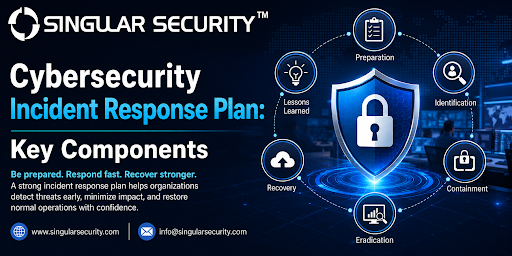
Most mature incident response programs are organized around six phases. This structure is consistent with widely used frameworks, including NIST SP 800-61, and gives a business a repeatable process rather than a one-off reaction.
1. Preparation
Preparation covers everything done before an incident occurs: defining roles and an incident response team, setting up communication trees, pre-approving vendor and legal contacts, and stocking the tools needed for forensic collection. This phase also includes tabletop exercises that test the plan against realistic scenarios.
2. Identification
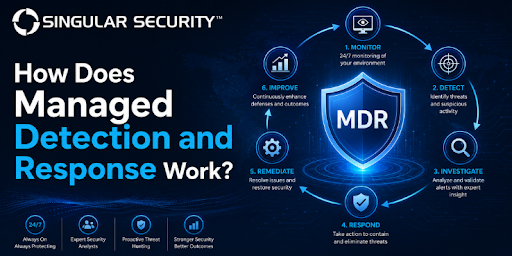
This phase is about recognizing that an incident is actually happening, separating a real intrusion from noise. Strong managed detection and response capabilities are what make early identification possible, since most incidents are far more damaging the longer they go unnoticed.
3. Containment
Containment stops the incident from spreading further, typically through short-term measures (isolating affected systems, disabling compromised accounts) followed by longer-term containment that keeps the business operational while the investigation continues.
4. Eradication
Once contained, the root cause has to be fully removed: malware, unauthorized access, or a vulnerability that was exploited. Skipping or rushing this step is one of the most common reasons organizations experience a repeat incident within weeks of the first one, a pattern seen repeatedly in ransomware attacks targeting organizations that reappear after an incomplete cleanup.
5. Recovery
Recovery restores affected systems and data to normal operation, but only after validating that the environment is clean and monitoring is in place to catch any resurgence. This is discussed in more detail below, since incident recovery deserves its own focus.
6. Lessons Learned
A post-incident review documents what happened, how the team responded, and what should change. This is also where a follow-up security audit adds the most value, confirming that the underlying gaps that allowed the incident are actually closed rather than just patched.
Building an Incident Response Strategy That Scales
A plan is a document; an incident response strategy is the operating model that keeps that document current and usable. A scalable strategy typically includes:
- Defined severity tiers, so a minor phishing report and a confirmed ransomware event don’t trigger the same escalation path.
- A named incident commander and backup, regardless of company size.
- Pre-negotiated retainer access to outside incident response consultants, so response time isn’t delayed by procurement.
- A communication plan covering employees, customers, regulators, and when applicable cyber insurance carriers.
- A recurring review cycle (at minimum annually) to update the plan as infrastructure, vendors, and threats change.
When to Bring in an Incident Response Consultant
Not every organization needs a full-time incident response team, but every organization benefits from knowing exactly who to call before an incident happens. An incident response consultant is typically brought in to:
- Build or stress-test an incident response plan against real-world attack scenarios.
- Lead the response during an active incident, including forensics, containment, and regulator communication.
- Provide the independent, well-documented incident report that insurers and regulators expect after a breach.
Businesses in regulated industries healthcare, financial services, and critical infrastructure tend to bring in consultants earliest, since their reporting windows are shortest and the operational cost of downtime is highest.
Incident Recovery: Getting Back to Business Safely
Incident recovery is frequently confused with containment, but the two serve different purposes. Containment stops active damage; recovery is the controlled process of returning systems to production once the environment has been verified as clean. Rushing recovery restoring systems before eradication is confirmed is one of the most common causes of repeat incidents.
A sound incident recovery process typically includes restoring from verified clean backups, staged reintroduction of systems (rather than all at once), heightened monitoring for a defined period after restoration, and a final sign-off from the incident response team before the event is formally closed.
Ready to Build an Incident Response Plan That Holds Up Under Pressure?
Singular Security’s incident response consultants help businesses build, test, and run incident response plans built for real attacks not just compliance checklists. Talk to our team to assess your current readiness and put a plan in place before you need one.
Frequently Asked Questions
Q1: What is a cybersecurity incident response plan?
It is a documented process that defines how an organization detects, contains, eradicates, and recovers from a security incident, along with the roles and communication steps required at each stage.
Q2: What are the key phases of incident response?
Most frameworks, including NIST SP 800-61, organize incident response into six phases: preparation, identification, containment, eradication, recovery, and lessons learned.
Q3: How is incident response consulting different from an internal IT team?
Incident response consultants bring dedicated forensic expertise, tested playbooks, and regulatory experience that most internal IT teams don’t maintain full-time, and they can scale up quickly during an active event without pulling staff off other priorities.
Q4: How quickly should a business respond to a cyber incident?
Immediately upon detection. Under CIRCIA, covered critical infrastructure entities will be required to report qualifying incidents to CISA within 72 hours of discovery and ransomware payments within 24 hours, and faster internal response generally limits both cost and downtime.
Q5: What’s the difference between incident response and incident recovery?
Incident response covers the full lifecycle of detecting and containing a threat, while incident recovery specifically refers to safely restoring systems and data to normal operation after the threat has been fully removed.
Q6: Do small and mid-sized businesses need a formal incident response plan?
Yes. Smaller organizations are often targeted precisely because they lack formal response capabilities, and a documented plan, even a lean one, significantly reduces recovery time and cost.