Zero Trust within Identity and Access Management (IAM) shouldn’t be considered a mere option anymore; it is, in fact, the most intelligent security decision that your company can make at this moment.
Did you know? According to the Identity Theft Resource Center 2025 Report, 36% of general consumers lost more than $10,000 to cybercriminals
Most of the breaches were caused by credential theft and inadequate access controls. Businesses that continue to use perimeter-based security are risking it big time. Simply giving people Data Security Awareness Training alone is not enough. You need a blueprint that treats every user, device, and request as a potential threat. And that blueprint is Zero Trust security.
Singular Security supports enterprises in establishing just that – a smarter, tighter and more intelligent security posture.
Key Takeaways
- Zero Trust is a security approach that continuously protects, always verifies, and analyses every access request before granting it.
- By implementing least-privilege access, one reduces the security risk exposure by getting rid of over-privileged users.
- MFA and conditional access strengthen defenses against credential-based cyberattacks
- Continuous monitoring that detects suspicious activities is facilitated, resulting in faster threat responses.
- Employee security training and Zero Trust together create stronger organizational protection.
How Data Security Awareness Training Connects to Zero Trust
Numerous businesses fund security awareness training for employees, but skip the structural changes that make training effective. Whereas training is mainly about educating people on the procedures, Zero Trust is about the real enforcement of these procedures.
Complementing each other, they offer multi-layered protection. One shapes behavior. The other controls access.
Why the Old “Trust Everyone Inside” Model Fails
The traditional security trusted anyone inside the network. As soon as you logged in, you could access the entire system. Though this concept is outdated.
The new forms of work, like remote working, using cloud applications, and dealing with insider threats, have rendered the network perimeter useless. It is no longer a matter of trusting someone’s location. You must verify identity at every step.
What Is Zero Trust Security
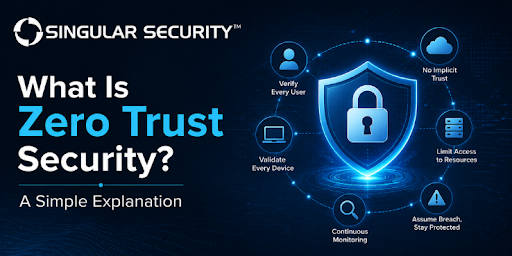
At the heart of Zero Trust security is this one principle: trust no one, verify everyone. It does not matter if a user is inside the office or at home. Any request to access the system is being checked. Every single time. No exceptions.
The model was formalized by NIST in Special Publication 800-207, which defines Zero Trust Architecture as a set of principles focused on resource protection and continuous verification.
Core Pillars of a Zero Trust Framework
- Verify explicitly: Authenticate and authorize by using every piece of data at your disposal.
- Use least privilege access: Allow users only the minimal level of access they need to do their work. Nothing more.
- Assume breach: Think of your designing systems in such a way as if the attackers are already inside.
Zero Trust Access Control: How It Works in IAM
Zero Trust access control sits at the heart of modern IAM. It replaces broad, role-based permissions with dynamic, context-aware decisions.
Here is how it works in practice:
| Access Factor | Traditional IAM | Zero Trust IAM |
| Authentication | One-time login | Continuous verification |
| Access Scope | Broad role-based access | Least privilege per session |
| Device Trust | Assumed trusted | Must be verified |
| Behavior Monitoring | Minimal | Continuous and adaptive |
| Response to Anomaly | Slow or manual | Automated and real-time |
Every login triggers a real-time risk assessment. The system checks device health, the location, the user’s actions, and the role of the user before allowing access. In case of anything suspicious, the system either rejects or challenges the access without any delay.
How MFA and Conditional Access Strengthen Zero Trust
Multi-factor authentication (MFA) is a core element in implementing Zero Trust access control. It effectively prevents attacks that use stolen credentials.
Conditional access policies are a step beyond. They assess the context of a situation before granting access. For example, is the device compliant? Is the location unusual? Is this access attempt happening at an odd hour?
These checks happen in milliseconds. The user barely notices. The attacker never gets through.
Building a Strong IAM Zero Trust Strategy

A solid IAM Zero Trust strategy does not happen overnight. It requires careful planning across people, processes, and technology.
Steps to Build Your IAM Zero Trust Strategy
- Map your identities: Know every user, service account, and device in your environment
- Apply least privilege: Get rid of extra permissions without delay.
- Enable MFA everywhere: Don’t allow any exceptions, mainly for privileged accounts.
- Segment your network: Limit how far a breach can spread.
- Monitor behavior continuously: Detect abnormalities that can mean incidents.
The Role of Continuous Security Monitoring
Continuous security monitoring is the element that really enables your Zero Trust approach to operate in real-time. Zero Trust without monitoring is like being blind. You verify at login, but then you are unaware of what happens next. Continuous monitoring observes the user’s behaviour after they have been authenticated. It detects any unusual actions. It alerts your security team fast.
In particular, for privileged users, this is very critical. Admins with extensive access to systems are often the main targets of attackers. Monitoring their sessions in real time reduces insider threat risk significantly.
What to Monitor in a Zero Trust Environment
- Failed login attempts and access denials
- Unusual data downloads or transfers
- Access outside normal working hours
- Logins from new devices or locations
- Privilege escalation attempts
Why Zero Trust and Employee Training Must Work Together
Data Security Awareness Training is what helps develop a human firewall. Zero Trust builds a technical one. You need both.
Technology, in spite of how excellent it is, can be compromised when employees click on a phishing link. Training is another way to reduce this risk. Training teaches staff how to recognize social engineering, report suspicious occurrences and comply with secure access methods.
Zero Trust then limits the damage when something slips through. If a compromised account tries to access sensitive data, Zero Trust stops it cold based on behavior and context.
Take Control of Your Identity Security Today!
Your business deserves security that is effective 24/7. IAM-based Zero Trust is not a fashion but the new standard for protecting your data, people, and systems.
Singular Security offers expert guidance on building and sustaining an IAM Zero Trust strategy uniquely suited to your business. Whether it is Data Security Awareness Training or continuous monitoring and identity governance, our team will help you remain protected and compliant.
Don’t wait for a security breach to take action. Contact Singular Security today and build a Zero Trust security program your business can rely on
Also Read This Blog:-
9 Ways Zero Trust Security Works to Stop Cyber Attacks.
Frequently Asked Questions
Q1. What is the role of Zero Trust in Identity and Access Management?
Zero Trust policy in the area of IAM drives the never-ending validation of a user and a machine, and granting contact with resources only after successful validation and checking. It does away with tacit trust and sets up strict, awareness-based access controls across your network.
Q2. How does Zero Trust access control differ from traditional IAM?
The conventional way IAM works is by providing users with access based on their roles and locations. Yet, with Zero Trust access control, it takes identity, device health and behavior verification at each session. Access is determined by the situation rather than the status of the individual.
Q3. Why is Data Security Awareness Training important in a Zero Trust setup?
Technology controls access, but it is the human element that can unwittingly open the door to the attackers. Data Security Awareness Training reduces phishing success rates and teaches employees to support, not undermine, your Zero Trust policies.
Q4. What is the first step in building an IAM Zero Trust strategy?
Begin with a comprehensive map of all the identities within your organization. A thorough understanding of each user, account, and device lays the groundwork for a robust IAM Zero Trust approach.
Q4. Where should we begin to build an IAM Zero Trust strategy?
Start with a detailed inventory of the identities in your organization. Knowing the users, accounts and devices will help set the foundation for a strong IAM Zero Trust strategy.
Q5. How can continuous security monitoring in a Zero Trust model be beneficial?
Continuous security monitoring recognizes irregular activities even after the user has been authenticated. In other words, the system will notify you if authorized users try to move laterally or access data in ways that are not typical for them.