Cybersecurity threats can create serious challenges for businesses, especially when there is no senior security leader to guide risk, compliance, policies, and incident planning. Did you know that IBM’s 2025 Cost of a Data Breach Report found that the global average cost of a data breach reached $4.44 million? This highlights why having clear security oversight can be important even before a serious incident occurs.
For growing organizations, understanding what a vCISO is becomes essential when they need experienced cybersecurity leadership without hiring a full-time executive. Singular Security supports organizations with security needs such as risk management, security assessments, threat monitoring, compliance, and incident response. A vCISO can bring senior-level security guidance to these areas while working alongside existing technology teams.
Key Takeaways
- A vCISO provides senior cybersecurity leadership without requiring an organization to hire a full-time CISO.
- The role can cover security planning, risk management, governance, compliance, and incident preparedness.
- A vCISO can work with internal IT teams and help connect technical security issues with business priorities.
- Organizations may use vCISO support when they lack senior security expertise or need additional guidance for a specific security program.
- The scope of vCISO support can vary according to the organization’s size, technology environment, industry, and regulatory requirements.
What Is a vCISO?
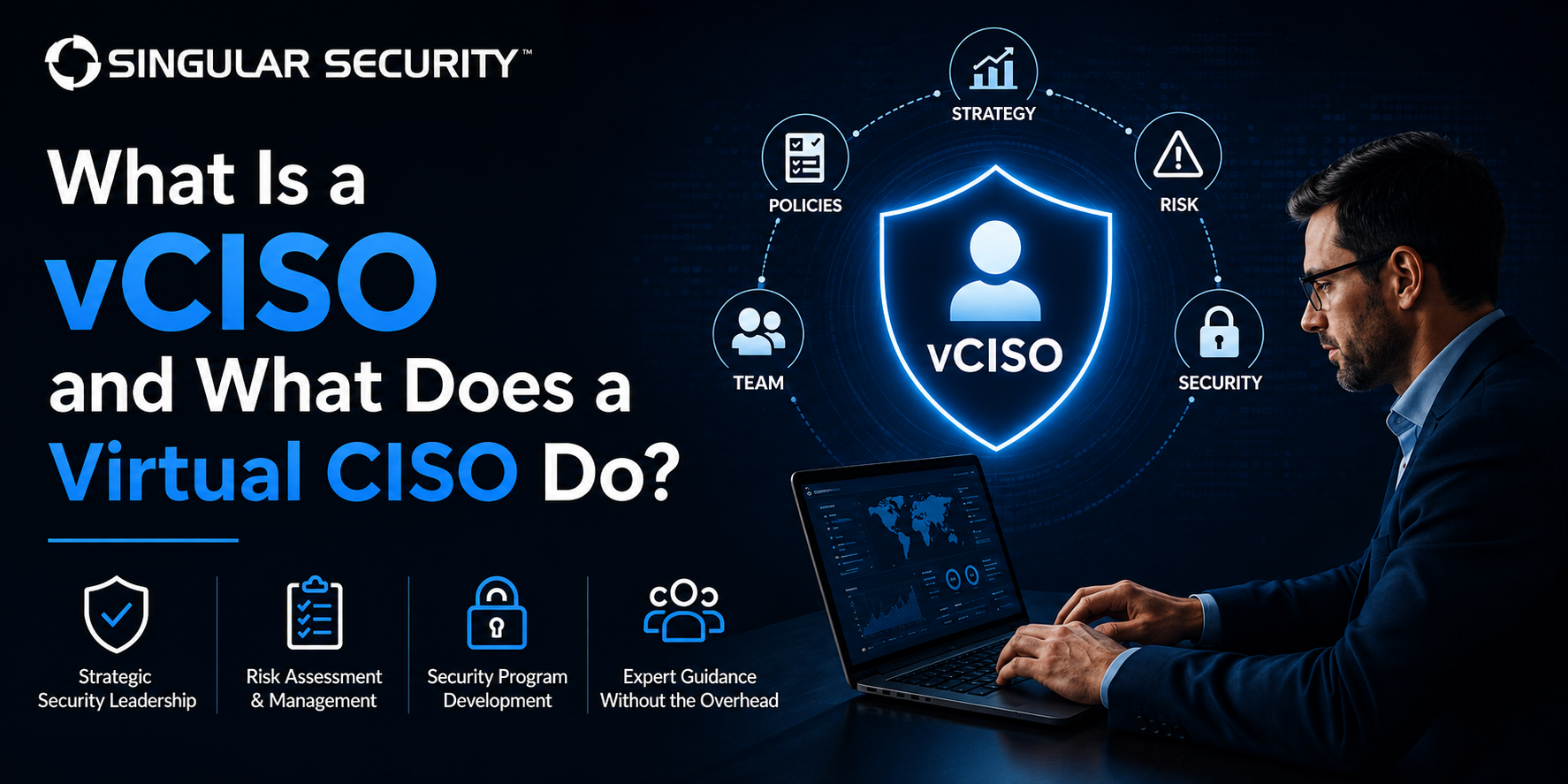
A vCISO (virtual Chief Information Security Officer) is an external security executive that offers CISO-level direction to a company. The position can be fractional or project based rather than full time executive depending on the needs of the organization.
So, what is a vCISO, in simple terms? It’s a way for a business to tap into senior security expertise without necessarily creating a permanent CISO role.
The vCISO can work with company leadership, IT staff, compliance teams, and other interested parties to identify current risks and set security priorities. This role is less about managing individual technical tasks and more about providing direction for the bigger security program.
What Does a Virtual CISO Do?
A virtual CISO can take responsibility for several areas of an organization’s security program. The exact duties depend on the company’s environment and current security needs.
Develop a Security Strategy
The vCISO assists in prioritizing security initiatives and developing a roadmap to enhance the organization’s overall security posture. This may include a review of existing controls, identifying gaps and where to focus attention first.
Assess and Manage Cyber Risk
Security decisions should be tied to business impact. A vCISO can help leadership to understand where the biggest risks are by looking at threats, vulnerabilities, critical systems and existing controls.
Support Compliance and Governance
Organizations may need to comply with industry regulations, customer requirements or internationally recognized security frameworks. A vCISO can assist with developing policies, organizing documentation, preparing for audits, and setting up governance processes.
Prepare for Security Incidents
A vCISO can also help organizations prepare for ransomware, phishing, data breaches, and account compromise events. This can include the development of response plans, responsibilities and tabletop exercises.
What Are the Main vCISO Responsibilities?
The role can cover a broad range of vCISO responsibilities, depending on the organization’s needs.
- Development and maintenance of security policy
- Security controls and cybersecurity risks review
- Setting security priorities and goals
- Supporting compliance and audit needs
- Planning incident response plans
- Assessing third-party and vendor risks
- Reporting security risk to business leadership
- Coordinating with the internal IT and security teams
- Tracking progress on security goals
The role also can help translate technical findings into information business leaders can use to make security and investment decisions.
When Does a Business Need a vCISO?
A company does not need to wait for a major breach before seeking senior security guidance. A vCISO may be useful when:
- The internal IT team manages security but lacks senior security expertise.
- Senior management requires better understanding of cyber threats.
The company is ready to be audited or certified.
- Security requirements imposed by regulators or contracts have risen.
More systems or data will be moved to the cloud.
- The company has experienced some security breach recently.
The firm needs assistance in establishing security policies and governance.
- A growing organization needs stronger cybersecurity leadership without hiring a full-time CISO.
What Services Does a vCISO Provide?
The vCISO services can help with strategic, technical, governance and compliance needs.
Common areas include:
Security Planning
Security roadmaps, policies, priorities, and program development.
Risk Management
Risk assessments, security gap reviews, vulnerability oversight, and remediation planning.
Governance and Compliance
Framework alignment, audit preparation, policy development, and security documentation.
Incident Readiness
Response planning, tabletop exercises, communication procedures, and recovery preparation.
Security Program Oversight
Security metrics, vendor reviews, executive reporting, and coordination with internal teams.
The level of support can change over time as an organization’s security requirements develop.
vCISO vs CISO: What’s the Difference?
The main difference is how the security leadership role is structured.
| CISO | vCISO |
| Usually a full-time internal executive | Usually an external or fractional security leader |
| Works as part of the organization | Works with the organization under an agreed engagement |
| Has an ongoing internal role | Can provide support based on defined needs |
| Requires a permanent executive position | Does not require a full-time CISO hire |
A vCISO is not simply a replacement for an internal CISO. The right choice depends on the organization’s size, risk profile, internal capabilities, and long-term security plans.
Benefits of Working With a vCISO
Access to senior security guidance can help organizations make clearer decisions about where to focus their resources.
Potential benefits include:
- Senior security expertise without a permanent executive hire
- Clearer security priorities
- Better visibility into cybersecurity risks
- Support with governance and compliance
- Guidance for internal IT teams
- Stronger incident preparation
- Executive-level security reporting
The goal is to connect security activity with the organization’s wider business requirements.
How Does a vCISO Work With an Internal IT Team?
A vCISO does not have to replace the existing IT department. Internal IT teams frequently manage networks, devices, applications, users, infrastructure, and day-to-day technological operations.
The vCISO is able to set higher level direction on security strategy, risk, policies, governance, compliance and security priorities.
This division can help technical teams understand which security issues require attention while giving business leaders a clearer view of the organization’s overall security position.
How to Choose the Right vCISO
Organizations should look beyond a job title when selecting a security leader. Consider:
- Experience with similar industries and technology environments
- Knowledge of relevant regulations and security frameworks
- Experience with risk management and security assessments
- Ability to communicate with technical teams and executives
- Experience with incident response and security planning
- Clear definition of responsibilities and expected outcomes
- Availability and reporting arrangements
The right fit should reflect the organization’s current security needs and future plans.
Common Misconceptions About vCISOs
A vCISO is just an outsourced IT manager
A vCISO focuses on security leadership, governance, risk, and strategy rather than general IT support.
vCISOs are only for small businesses
Larger organizations can also use external security leadership for specific programs, assessments, compliance work, or additional expertise.
A vCISO replaces the IT team
The role can work alongside existing IT staff and provide direction for security-related decisions.
The role is only about compliance
Compliance can be part of the job, but security leadership can also cover risk, policies, incident readiness, governance, and security planning.
Every organization needs the same services
Security requirements differ based on industry, technology, business size, regulatory obligations, and risk exposure.
Ready to Strengthen Your Cybersecurity Leadership?
Understanding what a vCISO is can be the first step towards finding the right level of security leadership for your organization. A vCISO can provide senior guidance across risk management, governance, compliance, incident preparation, and day-to-day security priorities without requiring a full-time CISO position.
Singular Security works with organizations to assess their security needs and build stronger security programs around their business requirements. Ready to bring experienced security leadership to your organization? Connect with Singular Security today and take the next step towards a stronger, more prepared cybersecurity program.
Frequently Asked Questions About vCISOs
Q1. What does vCISO stand for?
vCISO stands for virtual Chief Information Security Officer. It refers to an external security leader who provides CISO-level guidance without necessarily being employed as a full-time internal executive.
Q2. What is the difference between a CISO and a vCISO?
A CISO is generally a permanent internal executive, while a vCISO provides security leadership through an external or fractional arrangement.
Q3. What does a vCISO do?
A vCISO can guide security strategy, risk management, governance, compliance, incident preparation, security policies, and executive reporting.
Q4. When should a company hire a vCISO?
A company may consider a vCISO when it lacks senior security expertise, faces growing compliance requirements, needs help managing cyber risk, or wants additional security leadership without hiring a full-time CISO.
Q5. Can a vCISO work with an existing IT team?
Yes. A vCISO can work alongside internal IT and security staff, helping set priorities and provide senior-level direction while internal teams manage day-to-day technology operations.