A single compromised laptop can give an attacker a path into a much larger business network. Modern workplaces rely on laptops, desktops, servers, and cloud-connected devices, giving attackers more endpoints to target. Security teams therefore need visibility into what is happening on these devices, not just a way to block known malware.
Did you know? Verizon’s 2026 Data Breach Investigations Report found that vulnerability exploitation was involved in 31% of breaches, making it the leading initial access route for the first time in the report’s history.
Singular Security provides security services that include endpoint protection, threat monitoring, threat hunting, and response support. This makes endpoint visibility an important part of a wider security program. But what exactly does EDR do, and how can it help an organization detect and handle suspicious activity?
Key Takeaways
- Endpoint detection and response monitors activity across devices to identify suspicious behavior.
- EDR collects endpoint data that can help security teams investigate possible attacks.
- It can detect unusual processes, malicious files, suspicious connections, and other signs of compromise.
- Response features can help contain affected devices and limit the spread of an attack.
- EDR works alongside tools such as firewalls, identity controls, email security, and backups.
- Organizations should select EDR based on their endpoint environment, security needs, staffing, and response capabilities.
What Is Endpoint Detection and Response?
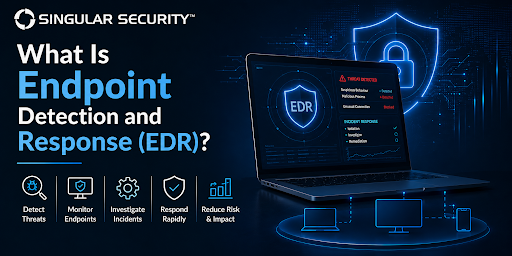
Endpoint detection and response is a security technology that monitors endpoint activity, identifies potential threats, supports investigation, and helps security teams respond to incidents.
Possible endpoints are:
- Laptops & Desktop Computers
- Servers and Work Stations
- Managed Devices by your Company
- Other systems connected to corporate networks
While basic anti-virus software might be only designed to recognize known malicious files, EDR can collect detailed information about activity taking place on a device. That provides security teams with more context when they investigate a suspicious event.
The process can be viewed through three core stages: detection, investigation, and response.
How Does EDR Work?
1. It Collects Endpoint Data
EDR software collects information from devices about processes, applications, files, network connections, logins and system changes. This data gives a timeline of activity that security teams can reference when something out of the ordinary happens.
2. It Identifies Suspicious Activity
The system looks for behavior that may indicate an attack. It could be a strange process launching, an unexpected script executing, a suspicious connection, or behavior that is not typical for the device’s activity.
3. It Supports Investigation
Security teams can review the data collected to see what has happened. They can identify the compromised device, user account, process and sequence of events. This can help determine if the alert is a real security incident.
4. It Supports Response
Depending on the EDR platform and configuration, teams may be able to isolate an affected device, stop a malicious process, or quarantine a file. These actions can help limit an attack while the investigation takes place.
What Does EDR Detect?
EDR can support endpoint threat detection across a range of security events. Its value comes from examining activity and behavior rather than relying only on known malware signatures.
Common examples include:
- Ransomware activity
- Malware infections
- Credential theft
- Suspicious scripts
- Malicious processes
- Unauthorized access
- Persistence activity
- Unusual network connections
- Potential insider activity
What Is EDR Security and Why It is Important?
EDR security gives organizations greater visibility into activity occurring across their devices. Security teams can use this information to investigate alerts, identify attack paths, and support incident response when a threat is confirmed.
Endpoint monitoring can also help teams identify patterns that may be missed when security data is limited to individual devices or isolated alerts.
EDR vs Traditional Antivirus: What’s the Difference?
| Traditional Antivirus | EDR |
| Focuses heavily on malware prevention and detection | Provides detection, investigation, and response capabilities |
| Often relies on known threat indicators | Can examine behavior and activity |
| Offers limited investigation data | Provides detailed endpoint activity |
| Response options can be limited | Can support device isolation and other response actions |
These technologies can work together. Antivirus can provide a basic layer of protection, while EDR gives security teams deeper visibility when suspicious activity occurs.
EDR vs XDR: What’s the Difference?
EDR is largely endpoint-focused, whereas XDR can ingest security data from a wide range of sources including endpoints, email, networks, cloud environments, and identity systems.
As such, EDR can be a component of a larger Cybersecurity program, especially if an organization requires detailed insight into endpoint activity.
When Should a Business Use EDR?
EDR may be useful for organizations that:
- Manage a large number of company devices
- Support remote or hybrid employees
- Handle sensitive customer or business data
- Need better visibility into endpoint activity
- Want stronger investigation capabilities
- Have limited internal security resources
- Need to improve their response process
The right security tools depend on the organization’s technology environment and risk profile.
How to Choose the Right EDR Solution
When comparing EDR solutions, consider the devices being protected, supported operating systems, detection capabilities, investigation features, response controls, reporting, integrations, alert volume, and available support.
An EDR platform is only useful when someone can review important alerts and take appropriate action. Organizations should therefore consider their internal staffing and response procedures before selecting a platform.
Common EDR Challenges to Consider
DR can also be a source of operational challenges. This can mean a lot of alerts in a large environment . And it takes skilled analysts to review and prioritize them . Bad configuration can lead to unnecessary notifications or gaps in visibility.
Then there is integration to consider. EDR should work with the organization’s existing security tools and response procedures, not as a standalone system.
How EDR Fits Into a Wider Security Program
EDR is one part of a bigger security program. It can integrate with firewalls, MFA, email security, vulnerability management, identity controls, SIEM platforms, backups and security awareness training.
The aim is to provide security teams with better visibility and clear steps for investigating and responding to threats.
Ready to Strengthen Your Endpoint Security?
Understanding how endpoint detection and response works is an important step toward building a stronger security program. EDR can give organizations greater visibility into device activity, help investigate suspicious events, and support faster action when a threat is identified.
Singular Security helps organizations strengthen their security posture through endpoint protection, threat monitoring, threat hunting, and response services. Ready to gain clearer visibility into your endpoints and improve your organization’s security readiness?
Connect with Singular Security today and explore the right security support for your environment.
Frequently Asked Questions About EDR
Q1. What does EDR stand for in cybersecurity?
EDR stands for Endpoint Detection and Response. It refers to technology that monitors endpoint activity, detects potential threats, supports investigation, and provides response capabilities.
Q2. How does endpoint detection and response work?
EDR collects activity data from endpoints, identifies suspicious behavior, provides investigation details, and can support response actions such as isolating an affected device.
Q3. Is EDR better than antivirus?
EDR and antivirus serve different purposes. Antivirus focuses heavily on malware prevention and detection, while EDR provides broader visibility, investigation, and response capabilities.
Q4. What types of threats can EDR detect?
EDR can help identify ransomware, malware, suspicious scripts, credential theft, malicious processes, unusual connections, and other activity that may indicate compromise.
Q5. Does a small business need EDR?
A small business may benefit from EDR when it has sensitive data, remote employees, multiple endpoints, limited security visibility, or a need for stronger detection and response capabilities.